
The strategy paper lands in the Board pack on a Thursday. Forty pages, well structured, all the competitors mapped and risks diligently called out, with a thoughtful section on AI and a respectable one on Sustainability. It took the Executive team a fortnight to finish, instead of the usual quarter. And, happily, for once nobody gave up a weekend to the formatting.
It is also, quite possibly, a plan that any competent competitor could have written in the same fortnight. This risk isn't new. Strategies converged long before AI arrived, shaped by the same consultancies, the same benchmarks and the same echo chambers. But AI has made the average plan cheap and quick to produce. A large language model gives the most likely answer to what it is asked. Give it a generic brief and it returns something sensible, balanced and close to the consensus, because the consensus is what most of its training material says. It will generate plenty of divergent options on request. It probably cannot judge which departure from the consensus is right for your business, because that depends on things it was never told.
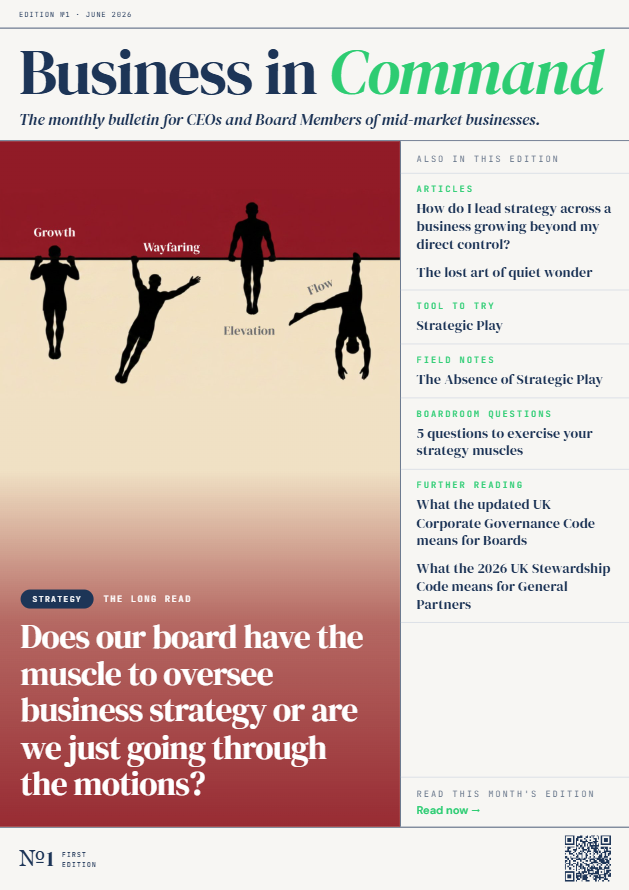
So the danger lies less in using AI than in letting it make the calls. Let's go back to the four strategy muscles that we argued, in our first bulletin, were increasingly critical for strategic planning in the current age. Where does AI help or hinder Growth, Wayfaring, Elevation and Flow?
Growth gains most. This muscle is all about curiosity: the openness to becoming lifelong learners and exploring new ideas born of previously unconnected concepts. A curious executive can reach a working grasp of an unfamiliar field in an afternoon: a CFO on how AI is changing the size and shape of finance teams elsewhere, a COO on how other businesses are using agentic AI to run customer service.
Elevation, the ability to build a broader understanding of a company's role in the world and decipher important signals from the deluge of daily information, gains too. Models scan and summarise far more than any strategy team. But their sense of what matters is skewed towards what has been written about most. The heavily discussed signal rises to the top. The early, thinly reported one, which might give a head start, sinks unless someone goes actively looking for it.
Wayfaring is where handing over judgement to LLMs costs most. This muscle is critical where past trends are ever poorer predictors of future outcomes, as leaders must become increasingly comfortable making decisions without precedent or perfect information. The better use of a model here is as a benchmark:
- have it set out the consensus view, so the team knows exactly what it is departing from
- have it argue against the team's judgement
- have it run a pre-mortem or develop a range of outlier scenarios
What is critical here is knowledge the model doesn't have, which is current, private and specific to your business: your customers, your people, last week's conversation with the regulator. Instinct built on past cycles won't fill that gap on its own, since experience is becoming a poorer guide. Advantage comes from that knowledge combined with the judgement to act on it.
Flow is the muscle AI most readily weakens. This is the muscle that allows leaders to say "I don't know" and "I was wrong", without blame or excuse, and it is critical when plans have to be evolved or stopped more frequently. Models seldom volunteer "I don't know" but lean towards agreeing with whoever is asking. A team that treats fluent AI output as unimpeachable adopts a confidence it hasn't earned, which is the opposite of Flow.
For the Executive team, there is a second cost. A plan drafted largely by prompt was presented to the team rather than forged by it. The alignment that comes from arguing through trade-offs together is lost. The practical line is to use AI to widen and speed up the inputs, keep the choices and the argument human, and mark clearly where the plan parts company with the consensus, and why.
For the Board, polish is no longer evidence of thought (which was often a reasonable yardstick in the past!), so the questions have to reach underneath it:
- Where does this plan depart from the conventional view, and what do we know that justifies it?
- Which assumptions came from judgement, and whose?
Back to that Thursday Board pack. Before signing it off, try one test. Imagine your nearest competitor had given the same model the same brief. How much of this paper would they recognise as their own?