
It’s the Annual Board Strategy Offsite. It opens with a “blue-sky” session on what would be different in 15 years, against a wallpaper of A0 mock-ups depicting a future of driverless cars, agentic AI workforces and a population of principled consumers. Then the refreshed strategic plan is presented. Tens of smart PowerPoint slides on economic, consumer and competitor trends. Perhaps a deep dive on The Customer of Tomorrow. The plan, associated financials and risks. Probably something on ESG at the end.
Challenges are raised, experience shared, quality of the slides duly praised. The plan is signed off subject to some more evidence being brought back on a few questions. After the obligatory Board Dinner, the day-to-day resumes with everyone a little more confident that the business is on the right path.
The motions of a strategy process have been followed. But none of the muscles that are truly needed to build strategic resilience in today’s environment have been exercised.
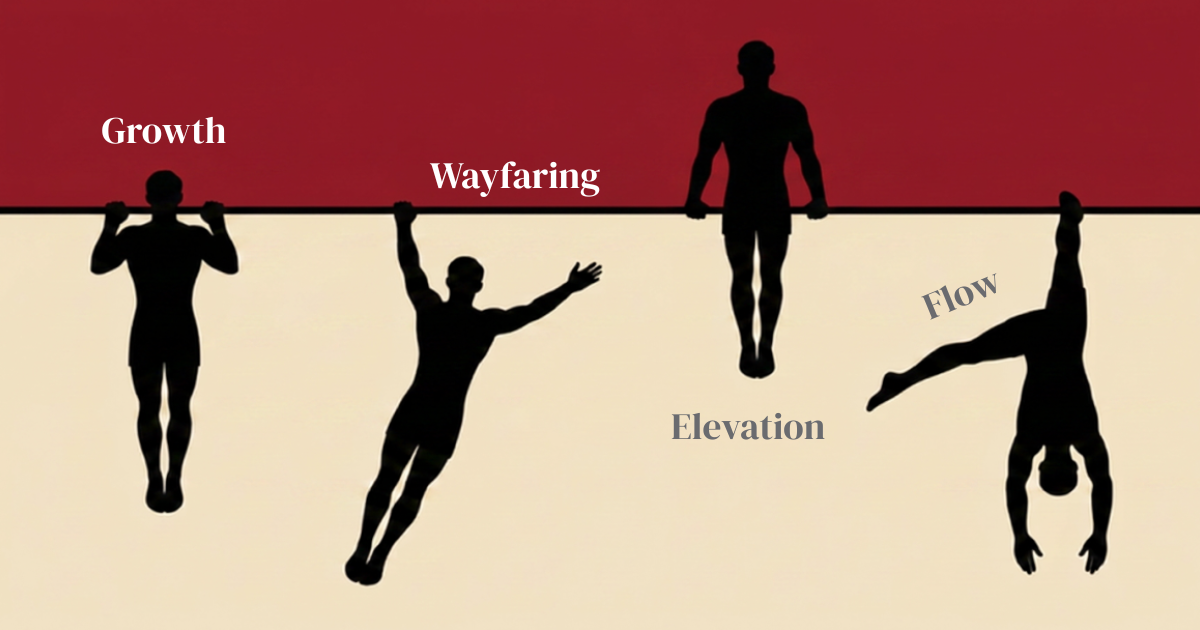
Strategic capability today isn’t a set of fixed traits that are either present or not, and it isn't solved by experience or sector knowledge alone. It's a set of specific, exercisable capabilities built for the world we now operate in. Curiosity to master lifelong learning, boldness to forge the untrodden path, perspective to read the whole Board, flexibility to bend without breaking:
Growth, Wayfaring, Elevation, and Flow.
Board Directors and their Management Teams need these muscles to face a level of strategic challenge that has no precedent in modern corporate life. The uncertainty bearing down on UK business today is structural and simultaneous: economic, geopolitical, technological, ecological and social pressures converging at once, each amplifying the others. Change is fast, relentless and unpredictable.
For decades, the valued capabilities that helped businesses into lucrative market positions were career length (perspective gained from leading through multiple credit cycles), analytical nous (ability to spot trends or assumptions that felt ‘off’), focus (ability to get the most out of the resources available over a short period), and conviction (confidence interpreting the facts and making – and defending – the right decision).
Leaders now face an environment where past credit cycles are not reliable predictors of what’s to come. Many trends and assumptions are rendered meaningless in the face of multiple, colliding macro forces. In this new era of plan-making, Boards are having to strengthen a new set of muscles in favour of those that they have relied on until now.
Growth.
The industrial revolution overturned the idea that human bodies were needed for physical work, leaving us to do the thinking. The digital revolution sped up the outputs of that thinking. The AI revolution challenges the idea that human minds are needed to do the thinking work. Traditional education and career experience does not sufficiently arm leaders for this transition. What they must lean on now is curiosity: to become lifelong learners and explore new ideas borne from previously unconnected concepts.
Wayfaring.
Where past trends become ever poorer predicters of future outcomes, leaders must become increasingly comfortable making decisions without precedent or perfect information. The position of fast follower is being challenged by a step-change in the pace of proposition deployment. The bold moves that define markets will be made by leaders assessing uncertain but plausible futures and bravely making a call.
Elevation.
The intelligence that now matters most for strategic planning relies on a broader understanding of a company’s role in the world and on the ability to decipher signals about influential long-term forces from the deluge of daily information. Where a focus on nearer-term patterns and financial outcomes used often to bring large rewards from the market, the longer view and sustainable outcomes are now starting to garner the respect of investors and accumulate value.
Flow.
Having all the answers, pushing forward with conviction, and being right were all previously seen as necessary to build respect from peers and colleagues. Today, such confidence can too easily be false. There are simply too many unknown, unprecedented, unpredictable factors at play. Real respect is now built from an ability to say “I don’t know” and “I was wrong”, without blame or excuse. Plans will have to be frequently evolved or stopped, and the leaders who initiated them must model that as acceptable.
Picture the next Annual Board Strategy Offsite. The business is behind plan, so the first session focuses on all the external, uncontrollable factors driving the lag. Time is spent examining the competitors in a similar position, and on why those that seem to be outperforming have different operational constraints. A new set of customer personas is brought to life. The adjusted plan, financials and risks are set out. ESG is still vaguely a thing.
It does not have to be thus.
When growth, wayfaring, elevation and flow are strong and working in concert, something greater than the sum of the parts emerges: Strategic Play.
The capacity to navigate uncertainty with curiosity, boldness, perspective and flexibility. After all,
For a Board, this isn't just about individuals being well-rounded - it's about the collective muscle profile. The strongest Boards – those that push their business to new levels of resilience and adaptivity – have spike strengths distributed across the four muscles, the self-awareness to know where the gaps are, and the resolve to build Strategic Play as an institutional asset.
The Annual Strategy Offsite may well endure. But for a Board adept at Strategic Play, the debate on the day will be real, open, uncomfortable and impactful.