Energy IS Prosperity: Why Abandoning Net Zero Forfeits Britain's Future
Why abandoning Net Zero exposes UK firms to trade barriers, higher cost of capital, and tech stagnation. The economic case for climate action over fossil fuel retreat.
Read →
Annual ESG fund inflows peaked at $645 billion in 2021. Within two years, after the invasion of Ukraine and the arrival of an organised anti-ESG movement across American politics, investment and regulation, net zero had become a phrase many UK Boards preferred not to say out loud in front of investors. Few businesses that set a 2050 target in 2021 have formally abandoned it. Plenty have downplayed, caveated or softened it.
Global investment in the energy transition rose in every one of those years, reaching nearly $2.1 trillion in 2024.
A Board that set a target in 2021 because the mood said so, and softened it since because the mood changed, has made two strategic decisions on the strength of sentiment alone.
The harder work is reading the reality underneath. The transition does not rest on a single metric: it is multifaceted, at times technical, and difficult for a strategy or sustainability team to condense into a picture a Board can decide on. Perigon's Low-Carbon Transition Index scores fourteen real-economy indicators against two pathways, where current government policy leads and what net zero by 2050 would require. Ten improved in 2024. Four are moving fast enough to deliver stated policy. Three are fast enough for net zero. Direction looks settled. Pace does not.
The part of UK decarbonisation that happened to businesses is largely done. The part that runs through their fleets, premises, products and suppliers has not started in earnest. Which makes now the time for a Board to ask whether the business has a suitable transition plan. Target with a plan behind it, target and no plan, or neither: next steps differ but the same discipline applies. Build up from the indicators on which the business model depends rather than backfilling from a top-down pathway or reacting to the prevailing mood.
Also in this issue

Why abandoning Net Zero exposes UK firms to trade barriers, higher cost of capital, and tech stagnation. The economic case for climate action over fossil fuel retreat.
Read →
Climate transition plans face a paradox - ambitious 1.5°C targets meet messy reality. How companies navigate Scope 3, net zero by 2050, and the integrity gap.
Read →Tool of the month
Fourteen real-economy indicators, each scored against where policy leads and what net zero requires. Three are on track. Ask the Data puts your question to the research and returns a cited answer, with sources attached, that you can drop straight into a board pack.
Try it →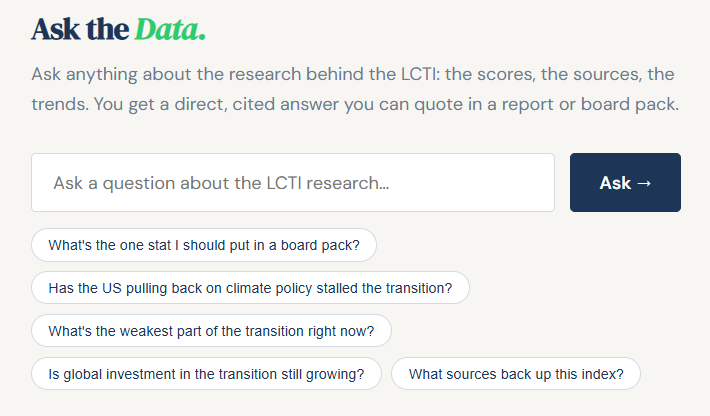
Further reading
Board Questions
With something like the climate transition, which has only started to land on the board agenda in the last few years, directors can often struggle with what to ask and executives can often struggle with what to present. These four questions give you a route into the grit of the issue when overseeing transition planning and avoid over-generalising it.
What are the three transition-dependent factors that our business model is most sensitive to?
Has our net zero position been revised in the last two years because evidence of transition pace or effectiveness has shifted, or because the political mood did?
Who in our Executive Team is considering how the transition to a lower carbon economy will impact our purchase, production and/or use of energy, fleets, premises, products and suppliers?
If carbon pricing reaches five times today's level by 2030, as every NGFS scenario now projects, how would it impact us or our key suppliers?
Field Notes
We've worked alongside a great client for about three years, providing corporate strategy and sustainability support. It employs about a hundred people, turns over less than £10m, and hasn’t yet broken into positive EBITDA territory. No regulation compels it to produce a transition plan today and, if transition plan disclosure is ever mandated in the UK, this business will sit well outside any threshold for years to come. Last month, we helped it build one anyway, recasting three years of incremental sustainability work (full Scope 1, 2 and 3 carbon estimation, detailed emissions forecasting, public Carbon Reduction Plan and Impact Report disclosure, oversight from a Board sustainability sub-committee etc.) into the structure set out by the Transition Plan Taskforce.
Why bother with a document nobody is asking for?
Because the value of a transition plan for a business at this stage has nothing to do with compliance. It has to do with the fact that a single document now exists, and every stakeholder who matters to this business can read the same one.
For Board Directors, it's the guiding construct: plans, targets, risks and opportunities set out in one place, ready to be discussed and challenged rather than assembled fresh and relitigated for each meeting. For debt and equity investors, it's a format they're increasingly used to seeing, built for quick and exhaustive review rather than a pack of slides that needs translating. For colleagues, it's a narrative they can actually follow: strategy and sustainability presented as one plan rather than two that happen to agree. For the upcoming B Corp recertification, lots of what the new Standards seek is already written down.
None of this required radical new thinking; it required framing existing work into a shape that serves every audience with one source of truth instead of a set of slightly different ones. And helps the business stay ahead of the game – with transition considerations at the centre of commercial decision-making.
Get Issue 4 the day it lands
Subscribe free →