.svg)
.svg)

Build to matter
Ready to work together?
If you’re an established or growing business ambitious about shaping your market—not just your margins—we’d be delighted to talk.
Scenario planning to explore 27 possible futures shaped by society, AI, and external shocks. A practical tool for leadership teams to build strategic foresight.
Emma Walford
December 11, 2025

TL:DR
We stand at a point of heightened uncertainty and unprecedented change. Our simple scenario planning prompts help leadership teams practice long-term thinking in a world that won’t stand still, helping build resilience and bend outcomes before it’s too late.
In a previous article (Big Cycles: Apathy, Dependence and a return to Bondage?) we mapped the present day onto Tytler’s cycle of civilisation (other Big Cycle thinkers are available) and concluded that we’re in the declining phases and likely close to a reset.
To stretch strategic thinking inside organisations, leaders need tools that provoke imagination without indulging in fatalistic prophecy. The aim is not to predict the future, but to practise thinking in it. A simple way to do this is to combine three forces shaping the next decade and explore what happens when they interact.
Below is a stripped back scenario tool built around three columns: society, AI progression and shocks. Each column contains three possible conditions. Pick one from each column and consider the world that emerges when all three collide. That gives us 27 – simplified – possible futures.
The exercise is intentionally straightforward. Its value lies not in precision but in the conversations and questions it provokes.
The role of the group is to pick one row from each column, combine them and sketch the outcome. What kind of society does that future produce? What pressures does it place on organisations? Where might power sit? Whose agency strengthens, and whose diminishes? And crucially, where does it place us on the civilisational cycle: bending, drifting or sliding?
Let’s see what this could look like in practice, starting with our table of prompts.
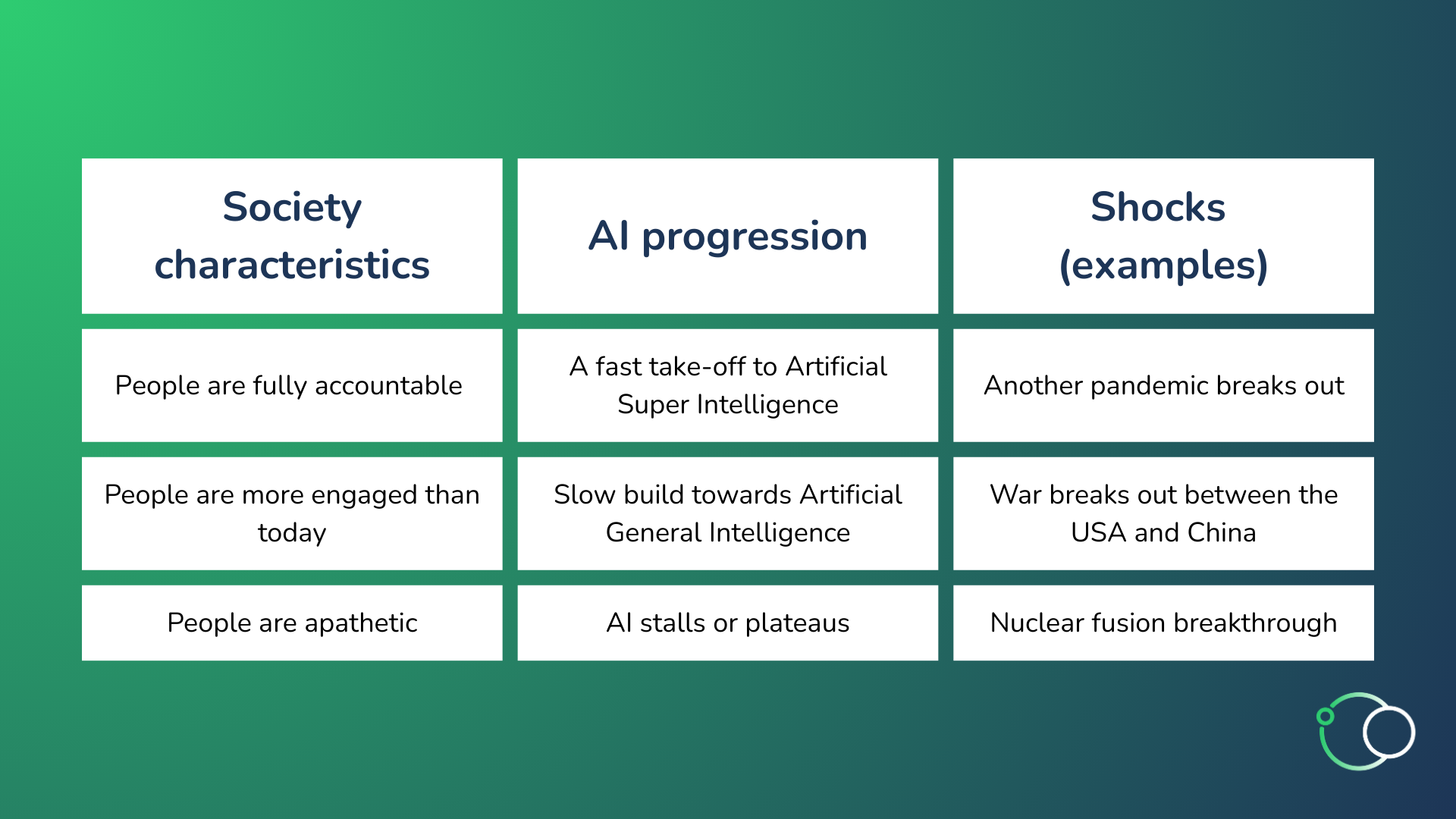
A society already drifting into apathy becomes more passive under renewed emergency conditions. Public tolerance for restrictions increases, not because trust in institutions has grown but because energy to resist has fallen. With AI stagnating, the technology does not meaningfully improve crisis response, so states rely heavily on the same tools used last time, only with less goodwill and more fatigue. Organisations find their workforces disengaged and difficult to mobilise. The cycle bends further towards dependence, and possibly towards quiet, administrative forms of bondage.
Accountable societies can absorb shocks with more coherence and will take steps to regulate AI so it acts in human interests. Tensions between the US and China escalate to the point of war but AI, working in the interest of humanity, brings both sides back from the brink. Organisations build long-term resilience rather than short-term fixes, and so are able to adapt–at a pace that protects livelihoods–to a largely AI-powered workforce. This one of the scenarios where the cycle could bend positively – away from some of the darker outcomes.
An engaged society begins with energy and intent, but the failure to regulate AI to ensure human interests are preserved before a fast take-off on super intelligence means it’s too little, too late. A breakthrough in nuclear fusion gives the new AI overlords unlimited energy to grow. Organisations and governments battle to maintain some agency over human lives and futures, but ultimately cannot course-correct the cycle from bending towards bondage to an artificial system that has consolidated all control and whose intelligence far exceeds ours.
These examples are intentionally brief. Their purpose is to show that even simple combinations carry weight. The point is not to create 27 polished essays, but to give leadership teams the chance to loosen their assumptions, practise uncertainty, and build the strategic reflexes needed in a world where the pace of change keeps accelerating.
What matters is the conversation that follows.
Those questions help teams recognise the levers still available to them, even in turbulent cycles.
If we genuinely are somewhere between apathy and dependence, then developing this kind of thinking is not an intellectual exercise. It is part of the work of bending the cycle while there is still time to do so, or at least being able to flex when full control of the influences is impossible.
At Perigon we can design the prompts that work for you and guide the in-person discussion that will meaningfully anticipate future scenarios.
© Perigon Partners Ltd. All rights reserved. Perigon Partners Ltd is a Scottish-registered company (SC716835).