Board and ExCo AI capabilities: a language to become fluent in, not a technology skill to delegate

Board and ExCo AI capabilities: a language to become fluent in, not a technology skill to delegate

Earlier this year, a Board Chair we know well spent a day at a conference on AI for Board Directors. Partway through, the speaker asked the room of about a hundred delegates to rate their own fluency with AI from 0 to 5. Hands went up at 1, and more went up at 2. Not one delegate placed themselves above Level 2.

It was only a show of hands, and self-assessment in front of peers can err in either direction. But the room had selected itself. These were directors who had given up a day to the subject, and the ceiling was a surprise.

That ceiling matters because the decisions now landing on Board agendas sit above it. Boards are being asked to approve plans to automate processes across teams, give systems access to customer data and let software act without asking first. All of that lives at Level 3 and beyond, and a director who has never been there is approving an architecture they have no first-hand basis to judge.

Read the full article →

Also in this issue

AI in strategic planning: where it earns its place, and where it costs you

AI in strategic planning: where it earns its place, and where it costs you

The strategy paper lands in the Board pack on a Thursday. Forty pages, well structured, and it took a fortnight instead of the usual quarter. It is also, quite possibly, a plan any competent competitor could have written in the same fortnight. Where AI strengthens the strategy setting process, where it weakens it, and how a Board can ensure the right level of human thinking is included.

Read →
AI and net zero: only one side of this ledger is bankable

AI and net zero: only one side of this ledger is bankable

Most boards approved an AI programme this year. Rather fewer revisited their transition plan, and almost none treated them as the same decision. Data centres used around 485 terawatt hours of electricity in 2025 and the IEA expects that to roughly double by 2030. How Boards can better balance the ledger between AI investment and the net zero transition.

Read →

Tool of the month

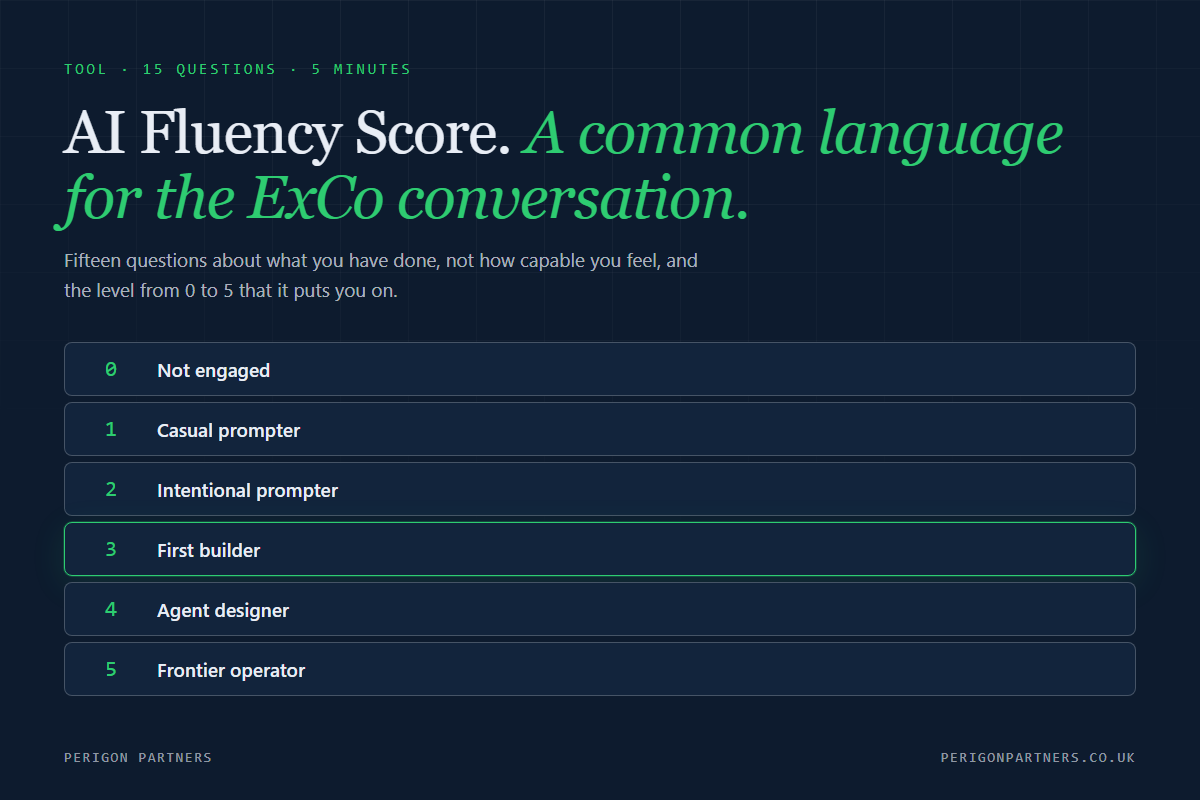
AI Fluency Score

Fifteen questions to place yourself on Perigon's own internal scale for AI capability in around five minutes. Are you an intentional prompter, like most Board and Executive team members, or are you more of a frontier AI operator?

Try it →
AI Fluency Score

Further reading


Board Questions

Most Boards have now approved an AI policy and at least one business case. Rather fewer could say where AI output currently enters a decision they are accountable for, or who looked at it on the way. Four questions to table at the next meeting.

  1. For a particular AI implementation case: what specific problem does this solve, and how does solving it connect to the three to five year plan?

  2. For the operations lead who owns the process being automated: where does a person have to check or approve the system's output before it acts, and what happens if that person is on leave?

  3. For the Data Protection Officer or General Counsel: whose data trains or feeds this system, and do we have the right to use it this way?

  4. For Procurement or Legal, before signing rather than after: if this doesn't work, how do we unwind it, and what would that cost?


Field Notes

  • It will be meaningless by Christmas

    Emma wrote our AI Adoption Scale in June, 0 to 5, and asked me to roll it out across the team. I sat on that task for three months and overthought it, which is very unlike me. Here's why.

    Every time I picked it up I could see what would go wrong with it. Each new AI model released by Claude, ChatGPT or Copilot absorbs a little more of the skill that used to sit at the level above. Careful prompting took real practice a year ago and takes almost none now, so a rung that used to mean something had dissolved. We are also still working out where AI genuinely earns its place in Perigon. Honestly? I thought if I rolled out the scale now, it would be meaningless by Christmas.

    Let me reassure you. The AI Adoption Scale will be meaningless by Christmas! We have rewritten it twice already and I expect that to continue for as long as the models keep moving. What I had wrong was treating that as a reason to wait, because the alternative on offer was never a better scale later. It was no shared language at all, and conversations about who could do what that went nowhere because nobody had the words for it.

    A rough scale that we may argue about every quarter has turned out to be far more useful than the stable one I was holding out for. If you are sitting on something similar because it is not finished, it is probably the same mistake.


Get Issue 5 the day it lands

Subscribe free →